


Short answer: Restart your training block in August, not September. Gym attendance in the US drops around 15% over the summer and rebounds 10–15% in September, so an August restart gives you three weeks of open racks. Rebuild volume gradually over the first four weeks, and pack a bag that separates shoes, kit, small gear and fluids.

Summer wrecks training schedules. Not because anyone gets lazy — because the structure disappears. Travel, heat, family, a gym that's half-empty and somehow still unmotivating.
Then September arrives, everyone comes back at once, and you're waiting twenty minutes for a rack.
Gym attendance across US facilities drops roughly 15% between May and August, then climbs back 10–15% through September and October. September is the second-biggest month of the year for gym sign-ups, behind only January.
Which means the people who restart in August get three weeks of quiet gym before the crowd arrives. That's the whole argument for going now.
Why August Beats September
Two reasons, and neither is about willpower.
Equipment access. In August you can superset. In late September you're planning your session around what's free. If your program has any structure to it — fixed rest periods, specific bar work, a squat rack for 40 minutes — August is when that program is actually executable.
Ramp time. Nobody comes back from eight weeks off at their old numbers. You need three to four weeks of rebuilding before you're training at real intensity. Start in August, and by the time the gym fills up you're past the awkward phase and into productive work.
The First Four Weeks: What Actually Changes
Coming back is a technical problem, not a motivational one.
- Week 1 — Movement, not load. Every main lift at a weight you could do for double the reps. The goal is remembering positions, not testing anything.
- Week 2 — Volume returns. Add sets, keep intensity conservative. This is where connective tissue catches up with muscle, and it's the week most people skip and pay for later.
- Week 3 — Intensity returns. Now you push. Working sets that actually feel like working sets.
- Week 4 — Normal programming. You're back.
Four weeks. Start the first week of August and you're running normal programming by Labor Day.
If you're returning from an injury rather than a break, the ramp is a conversation with a physio, not a blog post.

What Five Sessions a Week Does to Your Bag
Here's the part nobody plans for.
Training twice a week, any bag works. Training five times a week, with a real block, the load changes completely:
- Lifting shoes — flat or heeled, sometimes both
- A belt, and it holds its shape or it doesn't
- Knee sleeves and wrist wraps that are damp after every session
- Straps and a chalk bag that leaves dust on everything it touches
- A change of clothes, a towel
- A shaker and two bottles
- A 17" laptop, if you go straight from a desk to the gym

That's not a gym bag problem. That's a logistics problem, five days a week, for sixteen weeks.
A drawstring sack turns all of it into one pile at the bottom. You dig for a wrist wrap while your rest period runs out. Your belt spends four months folded against its own curve. Your clean shirt sits under your lifting shoes.
The Four-Zone Setup That Survives a Full Block
The benefit: you stop unpacking. Set the bag up once at the start of the block and it stays organized until the block ends.
The feature: four separated zones instead of one cavity.
- Shoe compartment — lifting shoes, isolated. Chalk dust and gym floor stay in one place.
- Main compartment — belt, change of clothes, towel. At 20" x 12" x 12", a belt lays flat here instead of getting jammed into a curve.
- Front organizer — sleeves, wraps, straps, chalk. Ten-second access, mid-session.
- Side pockets — two 750ml bottles, outside the bag where a leak costs you nothing.
The proof: the IronBackpack Pro 45L is built to that split — 45L of structured capacity, a 180° flat-opening clamshell so the whole loadout is visible at once, 900D water-resistant polyester with triple-stitched seams and YKK zippers, and a padded 17" laptop sleeve. It's rated 4.94 out of 5 across 50 verified reviews and carries a Limited Lifetime Warranty against manufacturing defects.
"This bag is spacious and perfect for all my athletic gear. It has a dedicated compartment for everything I need, making it easy to stay organized and ready for my next workout."
— Ronald Hernandez, Hybrid Athlete
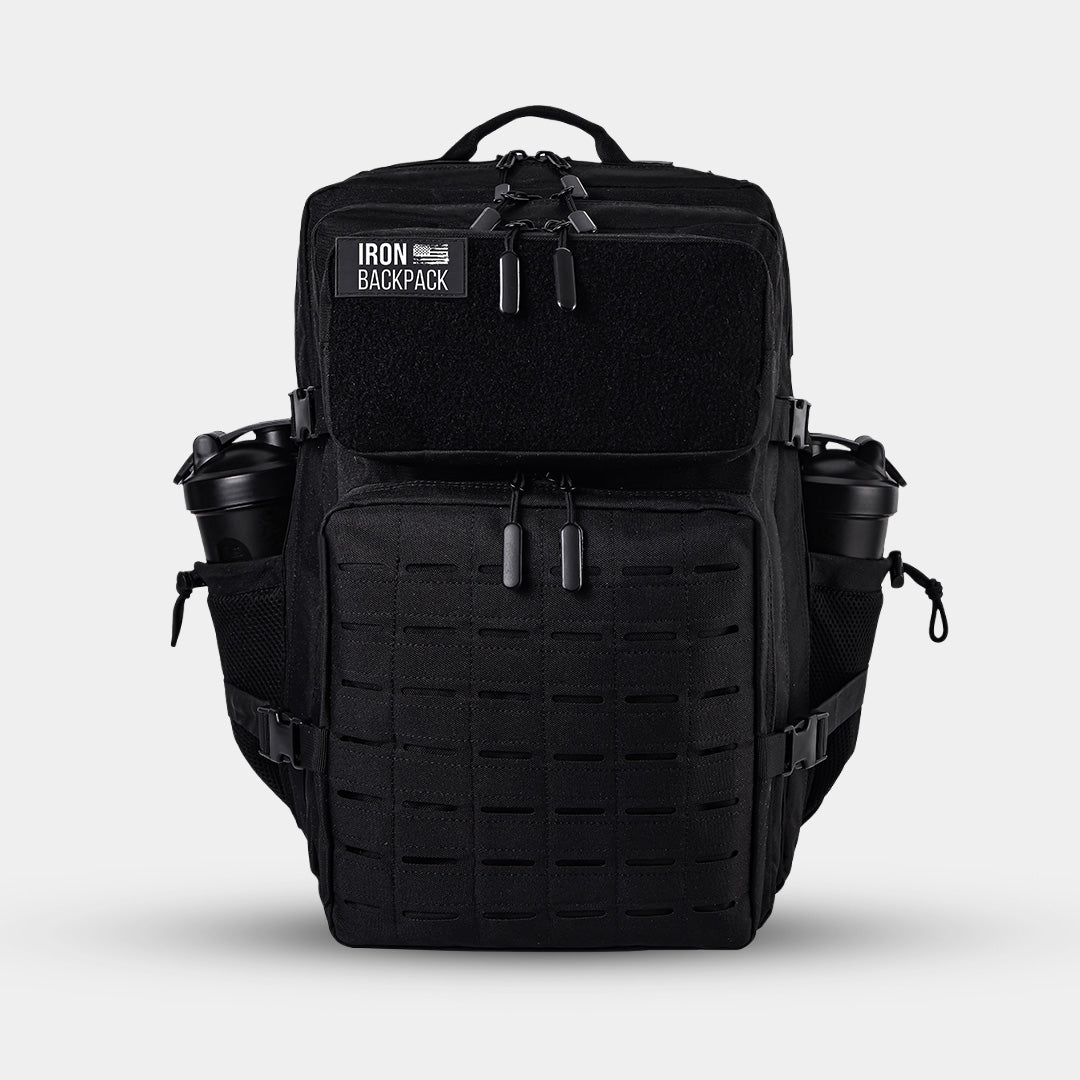
If you're also handling nutrition across a bulk or a cut — four to five meals a day, most of them eaten away from your kitchen — the Thermal 45L runs the same structure with an integrated insulated compartment (27.3 x 24.8 x 12.7 cm) sized for a full meal box, a shaker and cold fluids.
What to Check Before You Buy a Bag for a Full Block
Four things, in order of how often they fail:
- Zipper quality. This is what breaks first, every time. Look for a named brand — YKK is the standard — not an unmarked pull tab.
- Seam construction. Triple-stitched at stress points. A single-stitched shoulder seam under 20kg of gear is a countdown.
- Real separation. Not "pockets" — actual isolated compartments. A mesh divider doesn't stop chalk dust.
- Load rating. A bag rated to carry 20kg / 44lb has been tested with weight in it. Most bags publish capacity in liters and say nothing about load, which tells you something.
Then check the warranty. A brand that warranties a bag for life has made a bet on its own construction.
Browse the full range in gym backpacks.
Current Offer — Off-Season Is Over
Through the end of August, use code IRON8 at checkout for 8% off sitewide plus free shipping. Free tracked shipping ships on every order regardless. US delivery runs 6–10 business days after a 1–3 day dispatch — order early enough that the bag arrives before your block does.
Frequently Asked Questions
How long does it take to get back to your old numbers after a summer off?
For most lifters after six to eight weeks off, expect three to four weeks of rebuilding before you're training at full intensity again. Week one is movement quality, week two rebuilds volume, week three adds intensity, week four is normal programming. Skipping the volume week is the most common cause of setbacks.
What size gym bag do I need for training five days a week?
45 liters handles a full lifter's loadout: lifting shoes, belt, knee sleeves, wrist wraps, straps, chalk, a change of clothes, a towel, two bottles and a 17" laptop. Smaller bags in the 25–35L range work for two or three sessions a week, but force you to repack constantly at higher frequency.
Do I need a separate shoe compartment in a gym backpack?
Yes, if you lift in dedicated shoes. Lifting shoes carry chalk dust and gym floor debris, and a mesh divider won't contain either. An isolated compartment with its own zipper keeps clean clothes clean and stops your bag from smelling by week three of a block.
Is a backpack or a duffle better for the gym?
A backpack distributes weight across both shoulders and a back panel, which matters when the bag is loaded to 15–20kg. A duffle carries everything on one shoulder and offers no internal structure. For daily training at high frequency, a structured backpack is the more practical carry.
When should I restart training if I want to be ready for a fall meet?
USA Powerlifting Regionals run September 1 through October 31, so an August restart gives you the rebuild weeks plus a genuine peaking block. Starting in September compresses the ramp and usually means peaking on a base you haven't rebuilt yet.
Last updated: August 2026
